Hearing aids and your own voice
- 5 days ago
- 3 min read
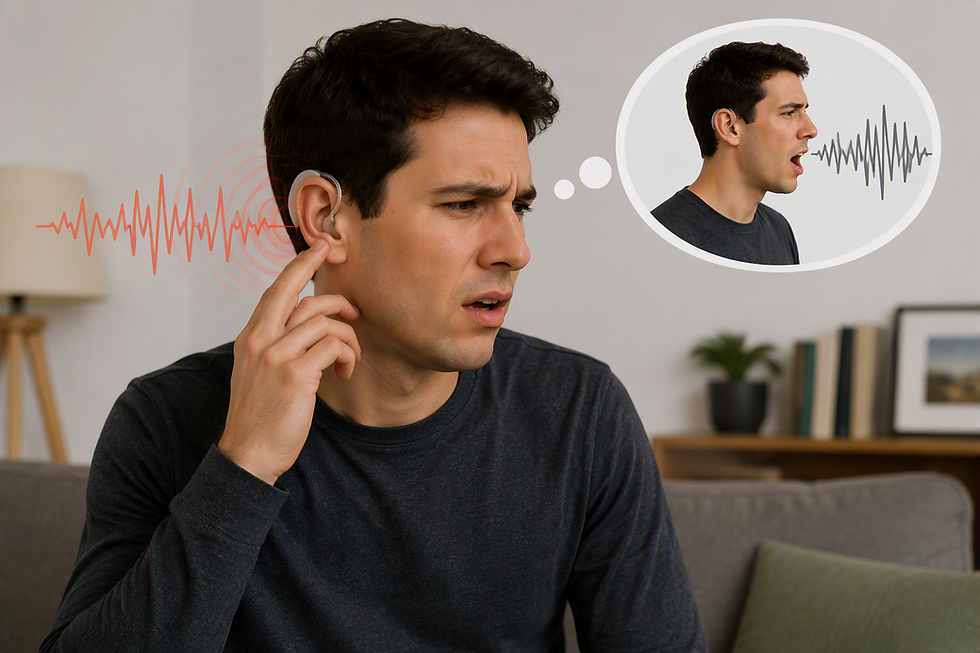
When you wear hearing aids, your own voice can feel different, strange, or too prominent. Many people find it challenging to wear hearing aids because your own voice doesn't feel natural, and we audiologists often get these descriptions from users we meet:
"My voice sounds hollow."
"It feels like I'm talking into an empty barrel."
"My nose sounds stuffy."
"The voice comes from inside the head."
This is one of the most common responses we receive from people who have recently started using hearing aids, or who have not received assistance with this problem before. Many people immediately think that the problem is due to a too tight earplug, but the explanation is often more complex.
How do we actually hear our own voice?
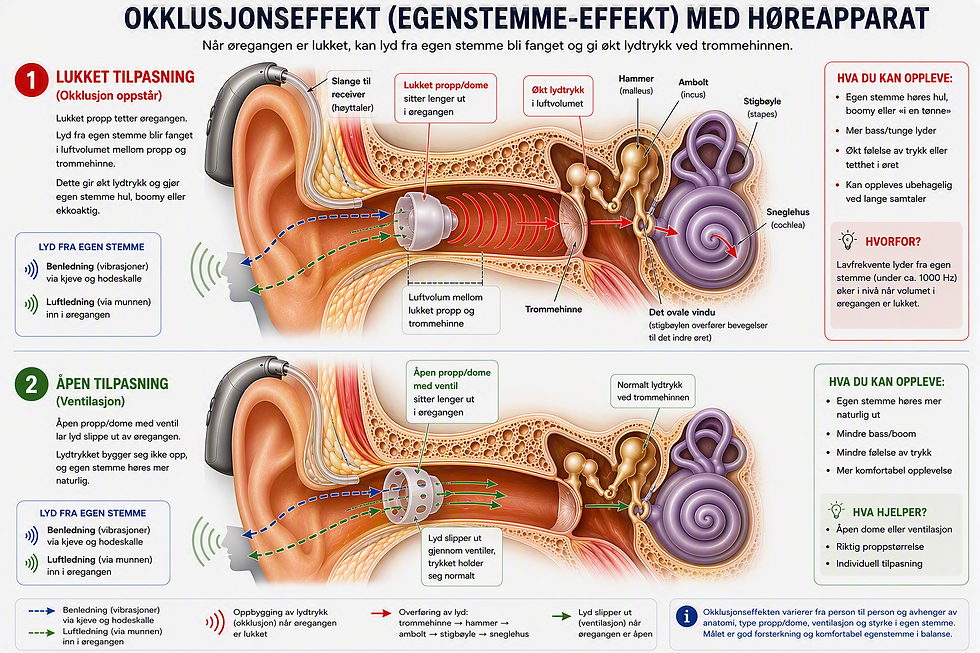
When we speak, sound reaches our ears in two different ways. One is through the air, in the same way that we hear other people. The other is through vibrations in muscles, tissues, and skull bones that conduct sound directly to the inner ear. It is the combination of these signals that makes our voice sound natural to us.
This is also why many people react when they hear their own voice on a recording. We mainly hear the airborne sound, and the voice sounds different than what we are used to.
What exactly is occlusion?
The classic occlusion effect can occur when the ear canal is blocked, for example with earplugs connected to hearing aids. Vibrations from your own voice are then trapped inside the ear canal and can significantly amplify the low frequencies. The result can be that the voice is perceived as deeper, louder or more resonant. In some cases, the level can increase by up to 20 dB around 250–300 Hz (Low bass frequencies)
Is it always the plug that is the problem?
Not necessarily. Newer understanding of voice perception with hearing aids shows that this may be due to an imbalance between the different signal pathways that contribute to how we perceive our own voice. If the hearing aid amplifies some parts of the signal more than others, the voice may be perceived as coming from the throat, nose, or from inside the head, even if the earplug itself is not the main cause.
Resonance in the sinuses also plays a role. Changes in how these frequencies are perceived can give a feeling of cold or congestion, even if you are not sick. Excessive earwax in the ear canals can also change the perception of your own voice.
Therefore, proper adaptation is important
When we fit hearing aids at AudioPlus, we first select hearing aids and earplugs based on the extent of the hearing loss , the shape of the ear canals, and the user's ability to place the earplugs in the ear canal. In conversation with the user , we get feedback on how the user experiences hearing conversations with other people, other ambient sounds, and also how their own voice is experienced.
Sometimes the solution may be a more open earplug or larger ventilation (air duct) in the earplug. Other times, the user is dependent on using tighter earplugs to be able to get enough amplification into the hearing organ due to severe hearing loss.
Problems with one's own voice can be solved by adjusting the hearing aid settings and the balance between different frequencies and the compression of the sound. It is therefore not always necessary to change earplugs if the voice is perceived as unnatural. If you are a completely new user of hearing aids, your own voice may also be perceived differently in the initial phase before your brain gradually gets used to hearing your own voice again.

Our goal is simple:
You should be able to hear your surroundings better – without your own voice feeling foreign.
Do you find that your voice sounds different with hearing aids?
Contact us via the contact form or call: 990 99 779 for more info and to book an appointment.
Often, small adjustments can make a big difference to both comfort and listening experience.
With kind regards,
All of us at AudioPlus Norge AS


Comments