Bone-anchored hearing aid (BAHA)
For most people with hearing loss, conventional hearing aids are a good solution. However, for certain types of hearing loss, a bone-anchored hearing aid (BAHA) may be a better option.
This is a specialised solution that transmits sound via bone conduction directly to the inner ear.

What is a BAHA?A bone-anchored hearing aid works differently from traditional hearing aids. Instead of sending sound through the ear canal and middle ear, vibrations are transmitted through the skull behind the ear directly to the cochlea (the inner ear). This can be a highly effective solution when there are issues with the ear canal or middle ear that make conventional hearing aids less effective.

Who may be a candidate?A BAHA may be an option for people who, for example, have:
Conductive hearing loss
Mixed hearing loss
Chronic ear problems or infections
Malformations of the ear canal or middle ear
Single-sided deafness (SSD)
It is the specialist healthcare service (ENT specialist) that assesses whether a person meets the criteria for this type of solution.
How do you proceed?If you would like to find out whether a BAHA may be suitable for you, the first step is usually to get a referral to an ENT specialist or hospital for further assessment and, if appropriate, surgery.
A referral can come from:
Your GP
A private ENT specialist with a reimbursement agreement
A public ENT department
As part of the assessment, tests are often carried out to determine how well bone conduction works and whether a bone-anchored system may provide greater benefit than conventional hearing aids.

Different BAHA solutionsThere are several different ways of using a bone-anchored hearing aid.
This is the most common solution. A small implant is secured in the skull bone behind the ear, and the sound processor is connected to it. Sound is then transmitted as vibrations directly through the bone. The titanium implant is surgically placed into the bone behind the ear and takes advantage of the body’s natural ability to allow bone to grow into the implant, a process known as osseointegration.
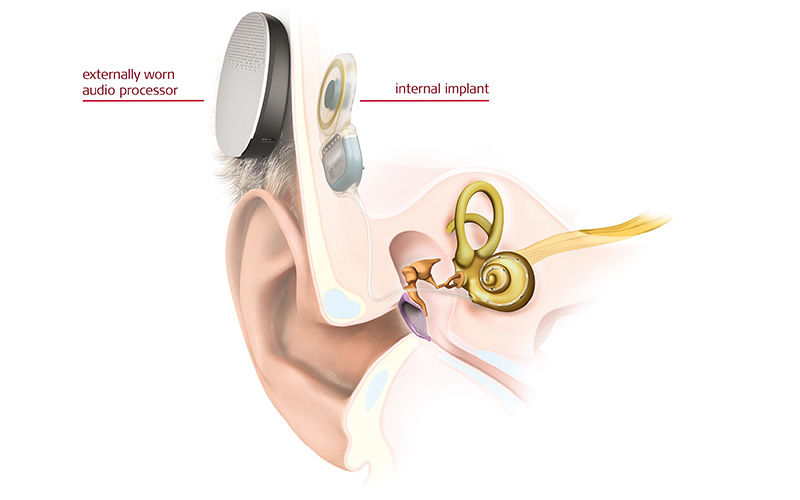
This is a user-friendly hearing solution that uses magnets to hold the sound processor in place over the implant. The sound processor then transmits sound to the inner ear. You simply position the sound processor (with the sound processor magnet) over the implant, and then you can go about your day while experiencing the sounds around you. See also the video here.
Headband or softbandThis is a solution where the sound processor is attached to an elastic headband. The vibrations are transmitted through the skin to the bone. This solution is often used:
For children who are not yet old enough for surgery
As a trial before possible surgery
For people who do not wish to undergo surgery.

How can we help as audiologists?As audiologists, we can provide:
Comprehensive hearing testing and digital ear canal examination via DigENT
Information and guidance about BAHA
An assessment of whether this may be worth investigating further

Would you like more information? Are you curious about whether a bone-anchored hearing aid might be an option for you or someone you know? You are always welcome to get in touch with us at AudioPlus.
We are happy to provide information, guidance and an assessment of possible solutions.
Kind regards, The audiologists at AudioPlus


Comments